Filing taxes every year is hardly anyone’s highlight of the day, We don’t know about you but we are 100% sure. We have never seen someone be happy while they fill out their taxes, Still, there is a big difference between trying to trick the system by avoiding paying taxes, which is against the law and will essentially land you in a lot of trouble, and using legitimate and safe ways to reduce the tax you owe to the government.
Let us examine the definition of tax evasion, how it differs from tax avoidance, and why it is illegal. Also share Difference between Tax Evasion Vs Tax Avoidance.
WHAT IS TAX EVASION?
Tax evasion is an illegal act of fooling the government by not paying the taxes that are owed. This can involve hiding allotted salaries, parking money overseas, and creating fake expenses to fool the government into under-evaluating taxable income. Do you remember the famous online travel agency Make My Trip? In 2023, Make My Trip was charged with a tax evasion case for the amount of INR 75 crores for the non-payment of service tax charged by the company, and however the company did put up a strong front. Still, it had to cave in and lost a significant amount of money it owed to the government.
Tax evasion is a criminal offense in the eyes of the law and any individual or corporate house indulging in this is eyed as an offender in the eyes of the government and the judicial authorities.
HOW TO RECOGNIZE TAX EVASION?
Throughout history, many attempts to hide the act have been made and it is equally essential to understand how to identify a case of tax evasion, there are numerous ways tax evasion can be identified and some of the most common ways are:
- When an individual earns a significant amount of money or an income through freelancing or a side business but does not report it while filing his income tax and willfully omits the exact amount of revenue generated through the suggested income methods.
- When a person claims his expenses that are lavish like trips, expensive gifts, lavish meals, and big purchases as business expenses in an attempt to hide his truly taxable income from a business.
- When a person attempts to hide his money in an unknown overseas account.
- Smuggling of goods and engaging in black market activities.
WHAT IS TAX AVOIDANCE?
Tax avoidance as a term, refers to the use of legal methods to
Minimize the amount of income tax owed by a person or a business to the government. This can be accomplished by using safe and legal methods to claim as many credits and deductions as possible on taxable income and it may also be achieved by investing in multiple tax savings instruments, which may help reduce a person’s overall taxable income.
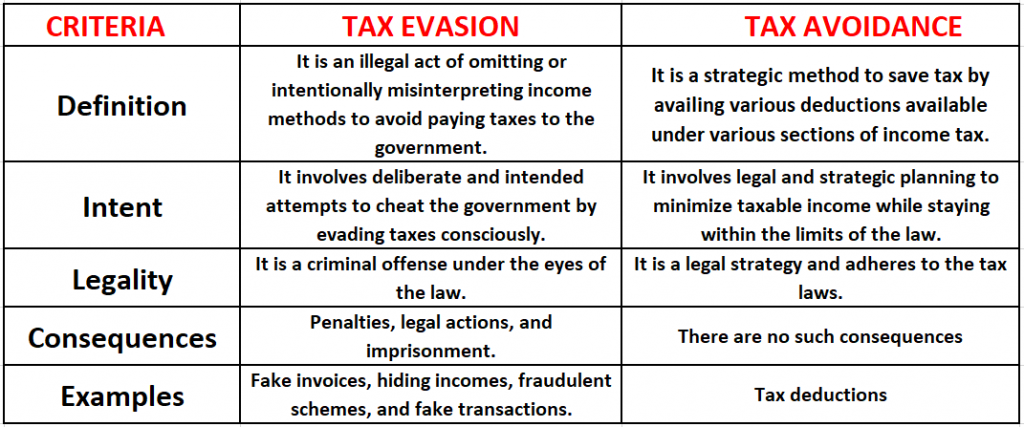
DIFFERENCES BETWEEN TAX EVASION VS TAX AVOIDANCE
Let’s try to understand the basic differences between Tax Evasion vs Tax Avoidance to understand the two terms much more clearly! It is crucial to understand how the two differ from each other to avoid any confusion.
UNDERSTANDING TAX AVOIDANCE BETTER
Tax avoidance is considered a legal and strategic method that is widely used by many taxpayers to avoid high taxes or to reduce their taxable income. Millions of people indulge themselves in legal and strategic activities that use some form of tax avoidance to deduct a portion of their owed taxable amount.
IS TAX AVOIDANCE LEGAL?
Remember Make My Trip? The company allegedly levied two types of tax, service tax levied on 60% of area rental price and service tax levied by the hotel on 10% of customer vouchers. Both these taxes were illegally levied and a lot of senior officials of the company got arrested and then released on bail afterward, this gives us a clear understanding of the repercussions that come along with tax evasion and hence it is normal to feel unsure and skeptical about the legality of tax avoidance as well.
Tax avoidance can be a legal way to minimize your taxable income when you use legitimate and safe strategies such as using tax credits and claiming deductions to your benefit.
Companies use different strategies to legalize their tax deductions such as offshoring their profits and and accelerated depreciation.
Tax avoidance might be a legal method of reducing your taxable income but it can also turn out to be an illegal method if you deliberately make it a point to avoid taxes that you owe to the government. Indulging in such malicious activities can lead to fines, penalties, and harsh punishments.
KEY FACT TO CONSIDER?
- Income level: your income level is also an important factor while deciding on a tax avoidance strategy as some tax saving schemes have upper limits on income levels that might not help you that much.
- Risk: different tax saving schemes carry varying risk amounts with them, your individual risk tolerance plays an important role here.
THE CONCLUDING LINE.
A lot of people pay taxes and a lot of them use efficient and legal tax avoidance strategies every day, contrary to what many people assume, tax avoidance is a safe and legal strategy to minimize your taxable income. There are several different strategies available at your disposal to choose from and avoid paying higher taxes like standard deductions and credits. There are limits to everything under the eyes of the law, make sure you stay within the lawful limits, enjoy reduced tax liability, and save a significant portion of your annual income.
Do not confuse it with tax evasion, which is illegal and a criminal offense that will lead to severe repercussions, when in doubt consult a financial professional or better, reach us at BFC Capital to enjoy your income and never worry about your taxes again!
Please share your thoughts on this post by leaving a reply in the comments section. Also, check out our recent post on “Understanding Large-Cap, Mid-Cap and Small-Cap – Best Mutual Fund for You?”
To learn more about mutual funds, contact us via Phone, WhatsApp, Email, or visit our Website. Alternatively, you can download the Prodigy Pro app to start investing today!
Disclaimer – This article is for educational purposes only and by no means intends to substitute expert guidance. Mutual fund investments are subject to market risks. Please read the offer document carefully before investing.