Frequently, it seems like we are experiencing a stock market correction, and that is no surprise. A stock market correction is always in the cards, and investors should understand what to do when they anticipate a tough ride.
Unfortunately, the market never lets you know in advance if there will be a bear market or if the market is at the top of correction and hence it is very essential to understand the market correction.
So, before any delay, let’s start understanding about the market correction.
What is Market Correction?
In the sector of finance and investments, corrections are not defined and specified when they will occur. However, they are meant to happen. as a change in the stock price from its latest peak state. Generally, a market correction takes place when there is a drop of 10% or more in the price of a security like individual stocks, currency markets, indices, and any asset that can be bought or sold on an exchange.
Assets, stock exchange indices, or the whole capital market itself may go under a correction for days, weeks, months, or a larger continued period. However, market corrections are usually of short period and last for around three to four months as per the recent financial evaluation.
Why Does Share Market Correction Take Place?
Market corrections are a measure of a healthy stock market as a consistent rise in the stock market might have unfavourable implications for an economy. Elevating share prices are identical to an economic rise; a constant increase in the values of benchmark signals might thus give rise to a high level of inflation, influencing resident individuals, specifically low-income groups. Market corrections also limit an asset from becoming overinflated, thereby hindering an asset bubble.
Though uncertain, market correction also promotes investments among long-term traders, as they can get the benefit of wealth accumulation via capital gains when the market gets better.
Such a drop in share prices is notably different from bear markets, as market correction enables an economy to rise even further upon revision of the prices of securities following their actual value.
How to Identify a Stock Market Correction?
Financial analysts and investors take help from different charting techniques to aid them in predicting and monitor market corrections. It is quite demanding to evaluate when such a correction occurs because the reasons can differ a lot, from large-scale economic changes to financial problems in the management approach of a single organization.
A change in the stock market rates taking place during a trading session is not good for short-term traders who could experience notable financial losses during such periods.
As it is hard to tell in advance about a market correction, it is unsuitable for experts to evaluate the beginning and concluding period of such a drop in stock prices.
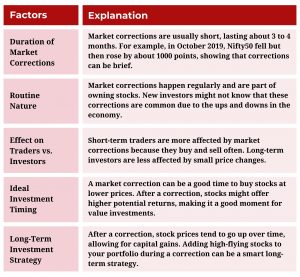
Factors to Review
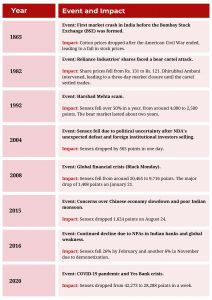
Historical Stock Market Corrections and Crashes in India
India has gone through various lists of stock market corrections and crashes over the years. Here are some of the popular events:
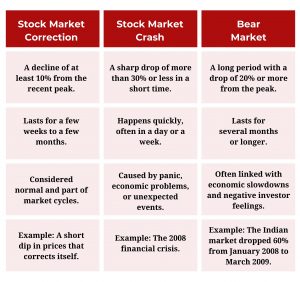
Difference Between Stock Market Correction, Stock Market Crash, & Bear Market
How to battle with Market Correction?
Most investors aim to participate in an inflated market by changing their funds over various stocks so that during a market crash, they can stay away from notable losses. This practice is called behavioral finance in the sector of investments and the share market.
Data suggests that many investors not only need financial prudence to stick with an elevating stock, but they also need to stay away from ill-advises regarding financial investments.
When market correction occurs, it is obligated to impact all equities, so investors should be well-informed and go with the following methods and strategies to avoid heavy losses –
- Choose Asset Allocation: Asset allocation is a form of financial planning, whose main goal is to balance market risks and rewards by allocating investor’s investments across different asset classes. It is suggested to have low financial exposure to upcoming market corrections as one comes near retirement. Hence, one should participate in the secure option by choosing asset allocation so that notable financial losses are not caused during a drop in stock prices.
- Invest In Government Securities: The inherent value of government securities doesn’t change with price variations, as the central/state government supports them. Individuals cautious of stock market investment at the time of market correction can opt to allocate their portfolios to such instruments, as they possess the security of principal and stable interest rates.
Conclusion
Stock market corrections are an essential part of investing. By gaining knowledge of the nature of corrections and incorporating effective techniques, investors can better battle these challenging times.
Understanding that the stock market can go up and down and knowing what causes these changes can help investors make smart choices and reach their long-term financial goals.
Please share your thoughts on this post by leaving a reply in the comments section.
Contact us via Phone, WhatsApp, or Email to learn more about mutual funds, or visit our website. Alternatively, you can download the Prodigy Pro app to start investing today!
Disclaimer – This article is for educational purposes only and does not intend to substitute expert guidance. Mutual fund investments are subject to market risks. Please read the scheme-related document carefully before investing. into account, that diligence and routine are significant factors in success if we talk about the world of stock market investing.








Name: How to Handle Market Crashes While Investing in Mutual Funds
says:[…] Also, Check – What Is a Stock Market Correction? […]