If we as an investor, invest in any of the stocks, gold, or any other type of investment we expect a good return from it. The first component that we generally search for in any investment product is how much return it has produced in the past. However, there are various methods of estimating return on investment.
You have heard of popular terms such as Trailing Returns, Rolling Returns, and Annual Returns. If not, no worries! In this article, we will tell you the 3 most widely recognized ways to measure a product’s returns: annual, trailing, and rolling. We will help you to understand what each of them signifies and in what ways they are different from each other, calculations, and significance.
Before anything else, let’s get into it!
What is an Annual Return?
The Annual Return signifies the cumulative gain or loss of an investment over one year, determined as a percentage. It involves both capital appreciation and dividends or interest. It’s a significant measure for investors to evaluate the performance of stocks, bonds, mutual funds, or other investment cycles over a year.
How To Calculate Annual Return?
To calculate Annual Return you have to follow 3 simple steps:
- Find the investment price (or Nav of mutual fund plan): Get the price of the mutual fund at the end of this year and the end of last year.
- Calculate the Difference: Subtract last year’s price from this year’s price.
- Find the Percent Change: Divide the difference by last year’s price.

Example
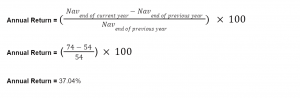
Let’s suppose your NAV of a mutual fund as of 31 March 2022 raised from ₹54 to ₹74. To calculate the annual return:
Trailing Return
Trailing returns are also another significant measure of investment performance that examines the returns of an investment over a specific period up to the present date. Trailing returns are generally utilized by investors and financial analysts.
Trailing returns are estimated by evaluating the returns of an investment over a fixed time period.They can be calculated over monthly, quarterly, yearly, 3-year, 5-year returns, even all the way till inception.

Example
Let’s assume today is August 15, 2024, and you want to find out the 5-year trailing return of the ABC Growth fund. Here’s how you would calculate it:
NAV on August 15, 2024 = ₹74
NAV 5 years ago, on August 15, 2019 = ₹54

Rolling Return
Rolling returns provide a different method to evaluate investment performance over a particular time, like one, three, five, or ten years. Dissimilar to annual returns which only give a picture of performance for a single year, rolling returns offer a more thorough view of how an investment has performed over different periods.
Example
To evaluate rolling returns, an investor chooses a particular time frame (e.g. five years) and a beginning point (June 1st). The investor then evaluates the investment’s return over the particular period that he has chosen, moves from the beginning point forward by one week or month, and reevaluates the investment’s return over the same period. This procedure continues until the investor has evaluated the investment’s return over every possible period.
Advantages & Disadvantages of Annual, Trailing, and Rolling Return
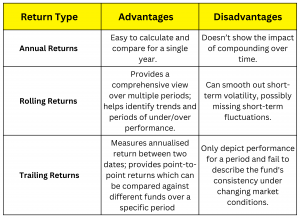
Annual Return Vs Trailing Return Vs Rolling Return – Which Return Should You Consider While Investing?
They can be beneficial for different objectives because all three types of returns annual, trailing, and rolling are used for different scenarios. For example, annual returns and rolling returns can be valuable in evaluating the changeability or consistency in a fund’s performance. The trailing return may not help on these aspects, but is very valuable to display the compounding effect on returns.
No sole return should be your only focus as an investor. Concentrating only on one type of return – rolling, trailing, or annual can make you miss the overall aspect. To make a smart investment you should consider all the three annual, trailing, and rolling returns.
To make smart investments, keep checking our blog page regularly!
Happy Investing!
FAQs
What is the Importance of Annual Return?
The yearly analysis of annual returns is important in calculating fund consistency and changeability around large market scenarios. Comparing a fund to its benchmarks or average for its category helps you see how well it performs compared to others in the market.
What is the Importance of Trailing Return?
Trailing returns provide a complete view of fund performance, allowing simple comparison between various funds over a particular period. This metric becomes very useful for investors searching for a more thorough understanding of the investment progress.
What is the Importance of Rolling Return?
Rolling returns provide complete knowledge of periodic fund performance, enabling investors to evaluate the consistency and possibility of earning particular returns over various investment periods.
Please share your thoughts on this post by leaving a reply in the comments section. Contact us via Phone, WhatsApp, or Email to learn more about mutual funds, or visit our website. Alternatively, you can download the Prodigy Pro app to start investing today!
Disclaimer – This article is for educational purposes only and does not intend to substitute expert guidance. Mutual fund investments are subject to market risks. Please read the scheme-related document carefully before investing.