Have you ever come across the term AUM in finance? Essentially, it represents the value of assets managed by an institution for its clients. Measures the size and efficiency of mutual funds, hedge funds, investment firms, and other important players in the finance sector. In this article, we get to know about the importance of AUM and how it is calculated.
What does Assets Under Management (AUM) stand for in finance?
AUM is the acronym for Asset Under Management, which is the total value of a financial firm or an investment specialist’s portfolio for consumers. These include shares, securities such as bonds, immovable properties and other
securities. AUM isn’t fixed; there isn’t a fixed amount that needs to be reached. Yes, because its value rises and falls under how the market fares when clients invest their money or withdraw
their funds and the particular decisions of the AMCs.
Why should one know about AUM?
Indicator of Size and Success: AUM serves as a metric for an organisation’s success. The larger the AUM, the company’s achievements and standing – to how popular pizza chains operate; more pizzas sold equals stronger brand recognition.
Revenue Generator: AMCs typically charge management fees on organisations based on the AUM percentage. Therefore, a higher AUM translates to a higher revenue.
Marketing Tool: AUM serves as a tool for enticing investors. Having a larger AUM indicates stability, reliability, and a proven history of success that attracts clients.
Regulatory Considerations: In some places, the level of AUM affects the regulatory requirements an AMC must follow. Bigger firms with higher AUM might face stricter regulations and compliance standards. With an increase in AUM, there are lesser total expense ratios, i.e., all costs incurred in running the fund are lower!
Calculation of AUM
The method for calculating AUM may vary depending on the institution and its operational model. The components that are required to calculate AUM are:-
Market Value of Assets: More specifically, this refers to the total market value of all the cash, stocks, bonds, etc., that are managed by the fund.
Investment Performance: Investment performance influences AUM. If the market value of the underlying asset is trading at a premium, the updated AUM will be greater than if the underlying asset is trading below par.
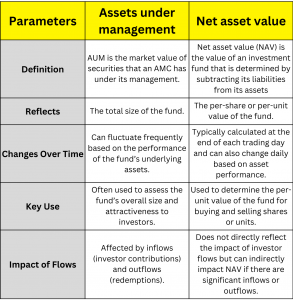
AUM vs. NAV
Who’s Got the Most AUM?
Let’s take a look at some players in the financial sector based on their AUM:
- HDFC Asset Management: Over ₹6.1 lakh crore
- ICICI Prudential Asset Management: ₹8.6 lakh crore
- SBI Mutual Fund: ₹8.87 lakh crore
- UTI Asset Management: ₹2.83 lakh crore
- Aditya Birla Sun Life Mutual Fund: ₹3.31 lakh crore
They manage large amounts of assets through various investment products underlining their important position in India’s financial system.
Conclusion
Assets Under Management (AUM) holds significance in evaluating the performance and impact of institutions and investment managers. AUM calculation is important not only for investors and clients but also for industry regulators. Understanding the factors influencing AUM can provide insights into the strength and stability of an investment firm. A high AUM typically indicates success as it signals attracting clients, generating revenue and outshining competitors in the financial sector.
Some crucial Questions related to AUM:-
What does AUM mean?
AUM stands for Assets Under Management. In terms it represents the overall market worth of all the assets that a financial firm handles on behalf of its clients.
How is AUM calculated?
We sum up the market values of all the assets under management, including cash, stocks, bonds, and real estate. To determine AUM, we adjust for clients’ deposits and withdrawals and the performance of their investments in the market.
What is the significance of AUM?
AUM carries weight because it indicates a company’s size and success. It determines how much money the firm collects as management fees, acts as a strong marketing tool, and even impacts regulatory requirements.
Is there a difference between AUM and NAV?
In companies, AUM represents the total value of all assets that are being managed. In contrast, NAV is the worth of each share in a mutual fund or an ETF. It can be achieved by taking away liabilities from assets and dividing them by the number of units outstanding.
Please share your thoughts on this post by leaving a reply in the comments section. Contact us via Phone, WhatsApp, or Email to learn more about mutual funds, or visit our website. Alternatively, you can download the Prodigy Pro app to start investing today!
Disclaimer – This article is for educational purposes only and does not intend to substitute expert guidance. Mutual fund investments are subject to market risks. Please read the scheme-related document carefully before investing.