In society, there are several countries and ethnic groups that are guided by cultural and religious laws. In food, medicine, education, and trade, people prefer to abide by the rules and regulations that are specific to their cultural values. When it comes to investment, mutual funds are no different. Shariah investing is one such investment plan!
Socially responsible investment (SRI) is a mutual fund strategy. Many mutual funds focus on social responsibility in their investments. Socially responsible investment is a mutual fund approach focused on ethics. It seeks good returns and a positive impact on society, based on social and ethical norms.
What is Shariah law investment?
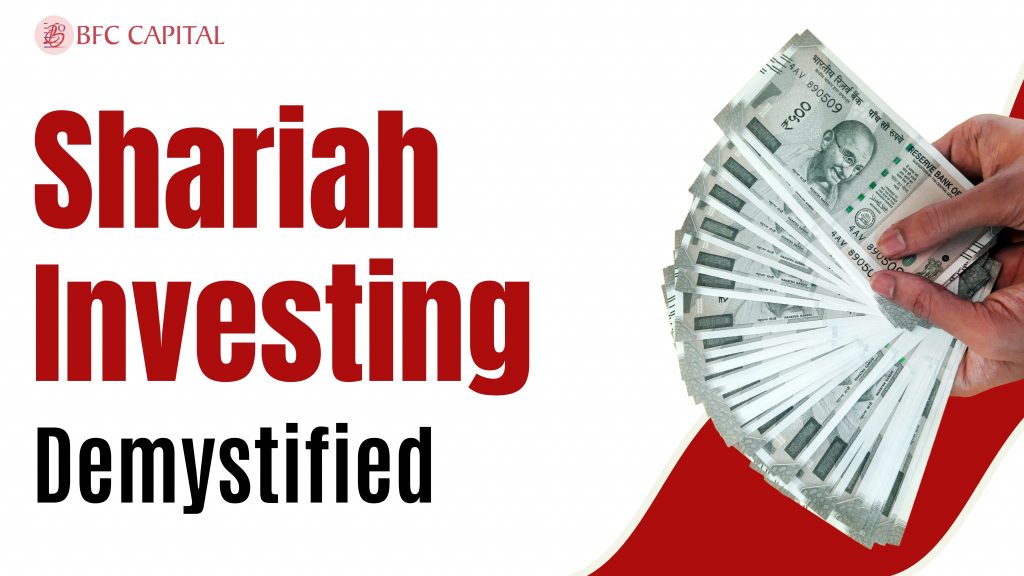
Shariah investment plans are a type of Socially Responsible Investment (SRI). They are however governed by the Islamic code of conduct. Shairat law, or Shariah law, is a set of rules and regulations based upon the Islamic religion.
According to industry experts, the global Islamic halal economy is set to reach a market value of $7.7 trillion by 2025, more than double the $3.2 trillion it came in 2015 and significantly higher than the $5.7 trillion it was valued at less than three years ago in 2021.
A report by the General Council for Islamic Banks and Financial Institutions revealed last year that the global Islamic funds market has grown by more than 300 per cent over the past decade, with nearly $200bn now under management globally.
What are the rules for Shariah-compliant investment?
Shariah investment schemes have strict rules and restrictions that must be adhered to by Shariah law. They include the exclusion of things that are prohibited in Muslim culture and inclusion of practices that are considered halal under the Islamic faith.Islamic investors follow these moral code of faith in finance.One common assumption is that non-muslim cannot utilize this but that’s not the case.Both muslims and non-muslim investors can invest in Shariah compliant funds.
Halal and Haram
Halal and Haram are both terms in the Arabic language. Halal means permissible, and haram means prohibited. Shariah investment requires complete avoidance of haram things, which is strictly not allowed in Islam. It promotes only being engaged with halal practices (permissible). In terms of investment transactions or trade, investments shall not be made in haram things such as pork, loans, selling or buying alcohol, gambling, etc. are not practiced. This also covers the complete avoidance of any sectors that are even related to the above-mentioned prohibited things. Unlawful and unethical acts such as fraud, theft, etc. in banking and investments are considered haram under Shariah investment.
Interest (Riba)
Riba is the Arabic term for interest in Islamic law. Shariah-compliant investment practices prohibit the use of interest in banking and investment; one cannot engage in any kind of investment that involves taking or giving interest. Shariah law considers money as only a medium if it is necessary for economic activities; hence, changing or adding extra value to the existing money is unlawful. Shariah-based fund houses do not engage in or invest in organizations that deal with revenue or interest.
Fair and transparent transactions
For halal investments in mutual funds, all transactions must adhere to transparency and fairness. Through the investment process, the investors usually follow this principle, but that cannot be the case for every organization. A clear one-on-one discussion is necessary before engaging in investments since different people approach their cultural and work ethics differently.
Risky transactions(Gharar)
Gharar refers to the uncertainty in the transaction process. Uncertainty and risk-associated investment are considered not allowed due to the risk of potential loss of assets. Investment always carries a certain amount of risk despite all mitigations; hence, it is suggested to avoid investments with excessive risk.
Sukuks(Fixed-income securities)
Sukuk is an investment certification that guarantees a share of ownership for the investors in the portfolio. Sukuk abides by the Shariah investment strategy that doesn’t involve interest; instead, owners receive the funds and revenue that are based on mutual fund performance. Also, the Shariah supervisory board verifies to check if the portfolio adheres to the Shariah investment. The Shariah advisory board includes Islamic scholars who oversee finance.
Sharing profit and loss(Mudarabah)
The profit and loss sharing principle of Shariah institutions states that all parties involved must equally share the risk and responsibility of benefits and rewards, which should be equally split among them.
This is known as Mudarabah, which ensures equal and fair participation of investors and stakeholders. If profit and loss are mutually agreed upon by all the shareholders, it balances out the profit/loss ratio of risk as reflected.
Asset backing principle
In Shariah compliant funds, all institutions must include the transaction of tangible assets. Tangible assets are physical assets, such as physical property. These assets must be beneficial for the owners. Moreover, assets with significant risk associated with such high debts and low values should not be traded.
What are the examples of Shariah-compliant investments!
Real estate, leasing assets, and commodities trading are some examples of Shariah-based investments. These funds do not engage in practices prohibited by Shariah law. The Islamic finance world is interested in investing in real estate mainly because of how ethically the property is used as an asset.
Through leased property (Ijarah), investors enjoy returns based on fixed income rather than interest. Both the buyer and financier mutually agree upon the funds; hence, it showcases fairness and transparency
Benefits and challenges of Shariah investment funds!
Due to the set of rules and regulations, Shariah investment has its challenges, and that makes it complex. For example, it might be time-consuming and costly to verify all the details for Shariah as per Islamic law. It might not be considered mainstream due to lesser exposure and its non-conventional approach. However, its fair share in profit and loss protects investors from a general loss of funds at investment. On top of that, its strict ethical practice to mitigate general risks of investment is notable.For those looking for socially responsible investments, it is a good idea to evaluate their benefits and drawbacks before engaging in them. Its unrealized potential needs to be explored more in the coming years.
Please share your thoughts on this post by leaving a reply in the comments section.
Also, check out our recent post on: “Mutual Fund Returns – What Are Types and Return Rates?”
To learn more about mutual funds, contact us via Phone, WhatsApp, Email, or visit our Website. Additionally, you can download the Prodigy Pro app to start investing today!
Disclaimer – This article is for educational purposes only and by no means intends to substitute expert guidance. Mutual fund investments are subject to market risks. Please read the scheme-related document carefully before investing.