Trailing and rolling returns:
Trailing And Rolling Returns are ways to measure how much money an investment has made. Trailing returns look back at a fixed period, like one or five years. Rolling returns are calculated over a set period that is measured over a duration of time. Both methods provide useful information for investors but have different methodologies.
In this article, we have discussed the meaning of Trailing and rolling returns, their features and limitations. Additionally, investors can also know which of the two is a better indicator by comparing both.
Trailing Returns Meaning
Trailing returns measure the performance of an investment over a fixed period. It is calculated by determining the percentage change in the value of mutual funds at the beginning and end.
The formula of trailing returns is
Trailing Return = [(Ending Value – Beginning Value) / Beginning Value] x 100.
For instance, if an investment was worth Rs 100 at the start of a year and Rs 120 at the end. Then, the trailing return would be [(120-100)/100] x 100 = 20%.
Rolling Returns Meaning
Rolling returns measure the performance of an investment over a fixed, moving period. Unlike trailing returns which look backward from a specific end date. Rolling returns calculate returns for consecutive fixed or annualized periods.
For example, a 12-month rolling return would calculate the return for the past 12 months. You can then shift the period forward by one month and recalculate.
The formula for each period remains the same as trailing returns:
[(Ending Value – Beginning Value) / Beginning Value] x 100.
The returns are calculated for several periods for a given time duration. Investors can identify the trends in performance by analysing these rolling returns.
Features of Trailing Returns
- Trailing returns calculate the performance of a stock from a specific starting point to an endpoint. This provides a direct measure of the investment’s return over that period.
- Trailing returns are calculated considering the past performance of the stock. Although these do not predict future returns, they can provide an insight into its track record.
- The calculation of trailing returns shows the difference between the ending and beginning values.
- Trailing returns of mutual funds are for fixed periods like one year, three years, or five years. They do not provide a continuous or ongoing performance measure.
- Trailing returns can be used to compare the performance of different investments over the same time.
Features of Rolling Returns
- Rolling returns provide a continuous evaluation of an investment’s performance. This is done by calculating annualized returns for consecutive periods. Due to this, it offers a more detailed report of the mutual fund performance.
- Rolling returns automatically adjust to changes over time in markets by using a fixed window size. As new price data is available, the oldest data point is dropped. With this, the return is calculated for the most recent window. This ensures the returns reflect the investment’s performance currently.
- Rolling returns can be used to identify trends related to a fund’s performance. Investors can analyse their performance to make informed investment decisions.
- Rolling returns can be helpful in volatility analysis. The variability of rolling returns over time can indicate the investment’s risk profile. Higher variability suggests greater potential for fluctuations in returns.
- Rolling returns can be used to compare the performance of different investments over the same window size.
Limitation of Trailing Returns
- Trailing returns only consider past performance over a specific period, potentially ignoring longer-term trends or volatility.
- High trailing returns might not indicate consistent performance. A fund could have had exceptional returns in the recent past but not a good performance. A strong trailing return doesn’t guarantee future success.
- Trailing returns might not account for different market conditions during the measured period, affecting comparability.
- It provides a snapshot of performance, not a comprehensive view of a fund’s risk-return profile.
Limitation of Rolling Returns
- Rolling returns reflect past performance and might not accurately predict future trends.
- Recent data points in a rolling return calculation have a greater impact.
- Rolling returns can smooth out short-term volatility, making risk appear lower than it is.
- The choice of rolling period can significantly influence results, making comparisons challenging.
- Rolling returns provide historical data but offer no direct insights into future market conditions.
Which is a better indicator of Mutual Fund Performance
Rolling returns are generally a better indicator of mutual fund performance than trailing returns. This is because the former offers a more dynamic view and allows investors to recalculate and analyze their returns over a set of years for a particular duration, such as 3 years. This helps to figure out term-wise fluctuations and reveal long-term trends.
For example, a fund might have a strong 3-year trailing return but a volatile rolling return, indicating inconsistent performance.
Trailing Returns vs Rolling Returns
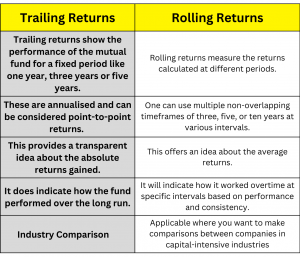
Choosing trailing returns or rolling returns confuses investors as both have different working mechanisms and calculation processes. Here is a detailed comparison between the two.
Conclusion
In conclusion, both trailing and rolling returns are valuable tools for measuring investment performance. Trailing returns offer a snapshot of past performance over a fixed period. Rolling returns provide a more comprehensive performance by re-calculating returns over consecutive periods. Trailing returns are useful for direct performance comparison over a fixed period. Whereas, Rolling returns provide a more detailed insight into performance, making them a better indicator of mutual fund performance.
Please share your thoughts on this post by leaving a reply in the comments section. Contact us via Phone, WhatsApp, or Email to learn more about mutual funds, or visit our website. Alternatively, you can download the Prodigy Pro app to start investing today!
Disclaimer – This article is for educational purposes only and does not intend to substitute expert guidance. Mutual fund investments are subject to market risks. Please read the scheme-related document carefully before investing.