Inflation
Imagine a world where everything revolves around pizza. It is the money, it is the familiar food, it is the icon of a great time. You, the great pizza lover that you are, have worked hard on your wages/ allowance and finally got the extra-large pepperoni pizza, the one with the long majestic crust from plate to plate. It sure is the real thing, so every slice that comes off is a triumph.
Fast forward a year. You return to your favorite pizzeria, wallet jingling with the same amount of cash you saved before. But a strange thing has happened. The pizzas… they’ve shrunk. The extra-large is now a mere large, the large a medium, and so on. The culprit? Inflation is the sneaky villain in the world of economics.
Inflation is like a mischievous imp who shrinks things down, not in size (well, not usually!), but in value. That same amount of money you saved up for your pizza just doesn’t buy the same amount of deliciousness anymore. It’s like the imp has taken a bite out of your buying power!
This, my friend, is the essence of inflation. It’s the gradual rise in prices over time, making the things you love seem more expensive, even though the actual money itself hasn’t changed. But fear not, fellow pizza lover! Just like any good adventure, there are ways to navigate this inflationary maze and keep your financial slices satisfyingly large.
This blog will be your roadmap, filled with tips and strategies to help you outsmart inflation. So, grab a metaphorical slice of knowledge, and let’s begin the journey to keep your finances – and your pizza dreams, nice and big!
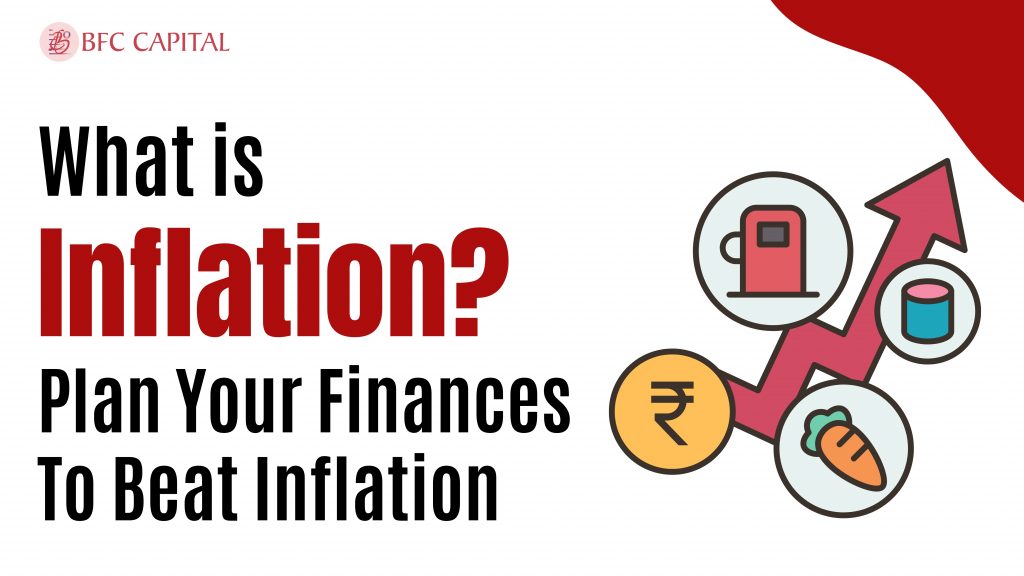
What Is Inflation?
Remember our pizza adventure? Inflation is the culprit behind the shrinking pies! But in the real world, it applies to everything, not just delicious cheesy goodness.
Here’s how inflation works: imagine yourself putting money as water in a bucket. With Inflation, the bucket starts to leak. Over time, the water (purchasing power) seeps out, even though you’re still putting money in. That means you will have less buying power over time.
In simpler terms, inflation is the gradual increase in prices of goods and services over time. It means the same amount of money you have today will buy you less tomorrow. Think of it as the value of your money slowly shrinking, like a superhero slowly losing their powers.
How To Measure Inflation In India?
Just like we need a measuring tape to track how much our kids are growing, economists use special tools to measure inflation. In India, the two main tools are:
- Consumer Price Index (CPI): This is the champion used nowadays. It adjusts the consumer price for a sample of goods and services that an average consumer uses in a country, in this case, India. Let a shopping cart heap with groceries, clothes, rent, transport, entertainment, and so on, represent the CPI basket. By tracking how much this basket costs over time, economists can calculate inflation.
- Wholesale Price Index (WPI): While not the main player anymore, the WPI is still used sometimes. It focuses on price changes at the wholesale level, which is when businesses buy things from each other. So, it reflects how much it costs businesses to get the goods they sell to you.
By analyzing both CPI and WPI (though CPI is more important now), the government and the Reserve Bank of India (RBI) get a good idea of how inflation is trending. This helps them make decisions to keep the economy stable and prices in check.
Strategies for the Average Indian Investor To Beat Inflation
When saving barely gets you by, it’s common to assume that’s enough. By investing, you can increase the size of your savings and transform them into a resource that appreciates in value over time. But it only happens when investing is done properly.
In a race against inflation, your investment will lose out if you purchase tools that yield less interest than inflation. Alternatively, you may keep up with inflation and have extra money after paying your expenditures if you use the right investment instruments to boost the returns on your savings. These are a few Indian investing alternatives; let’s examine if they have historically outperformed inflation.
-
Equity Mutual Funds
Equity mutual funds are an option for investors who do not wish to invest in individual stocks. Diverse investor types may find certain equity fund subcategories more suitable for their needs.
There are several types of equity funds available, such as funds that are based on investing techniques, market capitalization, sectoralization, tax savings, and more. As of 2024, the 5 and 10-year returns for the majority of equities fund categories were above 15%.
-
Gold
A “safe haven” is what experts all around the world call gold. Because the increase in gold prices and their associated returns have historically countered inflation, it is employed as a hedge against inflation. Gold cannot be defined as a paper commodity; it is an actual metal.
There is a study by the World Gold Council noting that demand rises by 2.6 per cent for each one percent hike in inflation and by 0.9% when GDP per capita hits a new record. This is true to most things in life, demand triggers a hike in prices and this is the bare truth of the situation.
-
Debt-Oriented Investments
Bonds and debt funds that invest in bonds are strongly correlated with the economy’s interest rates, which are directly correlated with rates of inflation. Interest rates increase in response to inflation. Bond prices and interest rates move against each other.
Bond prices will hence decrease in this scenario. Bond funds are susceptible to value loss in inflationary times. However, capital preservation, inflation-adjusted returns, and return management all depend on diversification.
-
Rebalance Your Portfolio
Rebalancing your portfolio involves moving its assets to reflect long-term market circumstances. One may need to rebalance their portfolio due to a variety of circumstances, including fluctuating inflation rates, financial goals, and many more.
For instance, a 2015 portfolio that took the state of the economy and inflation rates into account could not be beneficial to you in 2023. Therefore, reviewing your portfolio and making adjustments only when necessary is a crucial part of protecting it against inflation.
Covering Deflation: For Better Understanding
A persistent drop in prices is called deflation. This could be a sign of either an extreme reduction in the demand for goods and services or an overabundance of supply. Because of this consequence, companies are forced to cut costs and offer promotions in order to draw clients. Although deflation helps the individual, by lowering total consumption, it jeopardizes the stability of the economy.
These and other related effects demonstrate that deflation is a threat to the stability and health of the economy. A decrease in food prices, as well as basic metals, textile and cloth products, chemical products, and mineral oil, are the main causes of deflation.
In September 2023, when India experienced deflation in the Wholesale Price Index, the group of primary products which consists of food and minerals, recorded a 3.80% reduction in price negatively impacted the enterprises. Following this price change, businesses found it difficult to raise prices on consumers, which led to declining profit margins.
Concluding Points!
A long-term, cascading socioeconomic issue that has an impact on each person individually is inflation. However, it is not novel. In order to combat inflation, a variety of market tactics have evolved over time. Inflation is mostly caused by cost-push or demand-pull scenarios. You can outpace inflation, but you must constantly realign your portfolio to take the current rate of inflation into account.
Please share your thoughts on this post by leaving a reply in the comments section. Contact us via Phone, WhatsApp, or Email to learn more about mutual funds, or visit our website. Alternatively, you can download the Prodigy Pro app to start investing today!
Disclaimer – This article is for educational purposes only and does not intend to substitute expert guidance. Mutual fund investments are subject to market risks. Please read the scheme-related document carefully before investing.