Intraday Trading
Have you ever wondered how certain traders buy and sell stock within the day, squeezing in a profit (or loss) in that short span of time, never holding onto anything overnight? Intraday Trading is a rollercoaster, adrenaline-packed experience where stocks trade one moment and get squared off the very next.
Intraday Trading, as it’s called, is something of a unique stock market investment where trades get squared within the limits of a single day. This article acquaints you with what intraday trading is, how it operates, and the typical strategies and tools used to successfully manage it.
What is Intraday Trading?
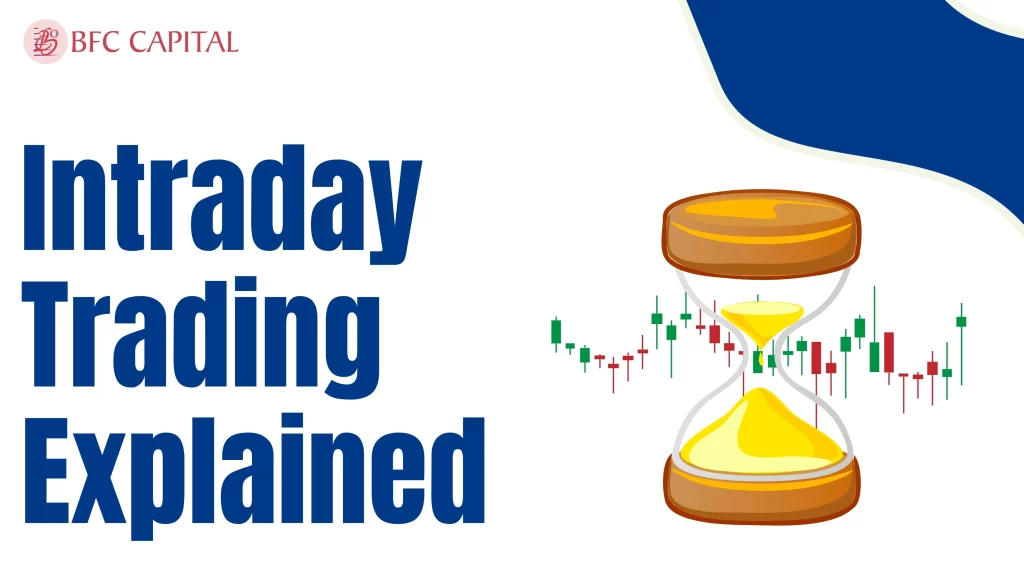
Intraday Trading (day trading in stocks) is the buying and selling of stock (or any other financial instrument) during the same trading day. The aim is to profit from prices fluctuating over the short term.
You do not invest or hold stocks for the long term, You trade them in a fast-paced market.
If you fail to close your position, the broker shall do it for you by the end of that day; hence, whatever profit or loss is made will be counted that day itself.
Where Does It Happen?
In India, intraday is mostly traded in stock exchanges such as the NSE and BSE. Working hours are from 9.15 A.M. to 3:30 P.M., Mondays through Fridays.
How Does Intraday Trading Work?
Let us understand this with an example:
You suppose the ABC stock is going to rise today. At 10 A.M., you buy 100 shares at ₹600 each.
By 1 P.M., the price has moved similar to your predictions to ₹620. You then sell all of the shares:
- Buy value: ₹60,000
- Sell value: ₹62,000
- Profit: ₹2,000 (not including taxes and charges)
You did not hold the stock beyond the day: classic intraday trade.
What is Margin Trading?
One of the advantages of intraday trading is the power of margin; you can buy stocks for a smaller amount of capital.
For example:
With ₹10,000, you could trade stocks worth ₹30,000 if your broker offers 3x margin.
Caution: A Higher margin means higher risks. Both profits and losses get amplified.
Why Do People Choose Intraday Trading?
- Instant profits
No need to wait causing months or years.
- A good risk
It can guard from getting into uncertainty due to some global events, results, or government policies that can affect the price movement after hours.
- Leverage technically means
trading on margin, which means a trader capitalises maximum trading power depending upon the margin provided by a brokerage.
- Daily income potential
Some treat it as a full-time job.
Common Intraday Trading Tools
1. Candlestick Patterns
Candlestick charts can help reveal price movement, along with opening/closing price and highs/lows. Intraday traders use this information to analyse how the market may move.
- Doji: market indecision
- Hammer: bull reversal
- Shooting star: bear signal
All of these patterns help to time entries and exits.
2. Technical Indicators
Intraday traders put more emphasis on technical analysis than on the fundamentals of companies.
Some of their indicators include:
- Moving Average: To identify the direction of the trend
- Relative Strength Index: To check for overbought/oversold zones
- Bollinger Bands: To check volatility levels
- Moving Average Convergance Divergance: To check for trend reversals
3. Stock Screeners & NSE/BSE Tips
- Any intraday screener may be accessed through multiple websites.
Caution: Blindly following stock tips would be dangerous. Always check through your analysis.
Popular Intraday Trading Strategies
1. Scalping
Ultra-short trades: buying and selling within a few minutes. Repeatedly attempts to make minor profits.
2. Momentum Trading
Buy stocks that are witnessing upward movement in price and ride the wave.
3. Breakout Trading
Buy when the stock breaks resistance or support levels with volume.
Tips for Beginners in Intraday Trading
- Choose liquid stocks (high trading volume)
- Set a stop loss, limiting the amount you are willing to lose per trade
- Stick to 1 or 2 stocks per day (better focus)
- Avoid the first 15 minutes of market open, when volatility is high
- Have a target price; don’t get greedy
- Never make a trade on rumours or emotion
Risks of Intraday Trading
- Extreme volatility: Sudden price swings may wipe out your capital.
- Emotional decision-making: Fear and greed usually lead to mistakes.
- Margin risks: Leverage magnifies the magnitude of losses.
- No compounding: There is no growth of wealth over time, unlike long-term investment.
- Brokerage & taxes: Frequent trading will mean higher costs.
Also, Check – Difference Between Trading and Investing?
Final Word: Should You Do Intraday Trading?
Daily trading is not everyone’s cup of tea as it requires:
- Being instant in the decision-making process
- Taking risks
- Having knowledge of technical analysis
- Maintaining control over emotional outbursts
If one can stand the stress and apply all the strategic working methods correctly, then it becomes a medium for short-term gains.
If one would rather have regular wealth accumulation, then mutual funds, SIPs, or long-term investment options would be the way to go.
Please share your thoughts on this post by leaving a reply in the comments section. Contact us via phone, WhatsApp, or email to learn more about mutual funds, or visit our website. Alternatively, you can download the Prodigy Pro app to start investing today!
Disclaimer – This article is for educational purposes only and does not intend to substitute expert guidance. Mutual fund investments are subject to market risks. Please read the scheme-related document carefully before investing.