
Are you wondering about how companies analyse their financial performance? Or trying to understand what metrics management and investors use to evaluate whether a company is profitable and efficient? Then you must be exposed to these few concepts. Return on Equity (ROE) and Return on Capital Employed (ROCE) is used to understand the company’s profitability and efficiency in management. These measurements assess a company’s ability to generate returns.
Understanding ROCE with Example
Return On Capital Employed (ROCE), being a profitability ratio, accurately presents the ability of a company to make profits using the capital employed. The return on capital employed is viewed as the best profitability ratio and it is preferred by most investors while selecting whether the particular enterprise is appropriate to invest in or not.
Formula
ROCE = EBIT / Capital Employed
Where, ROCE is Return on Capital Employed,
EBIT is earnings before interest rate and tax payments and,
Capital employed is total assets minus current liabilities
Example:
You and your friend decide to open a coffee shop. For this, you both invested ₹200,000. Later to expand the business you took a loan of ₹100,000. Now the capital is ₹300,000. Suppose the annual profit of the shop excluding interest and taxes is ₹60,000. Return on Capital Employed (ROCE) determines the utilization of total capital in the production of profit within the business.
Here, ROCE = Net profit = ₹ 60000 / ₹ 300000 = 0.20, or 20%. This means that if you invested ₹100 in your coffee shop, you are making ₹20 of profit before interest and tax.
How does ROCE work?
- ROCE gives an idea not only of a company’s profitability but of the capital Input by which that profitability is achieved.
- It is especially useful when capital intensive companies,heavy industries, for example in the oil and gas business, which belong to the capital-intensive field.
- ROCE is used to compare the profitability levels across companies where higher results show better performance.
- According to the use of ROCE, apple-to-apple comparison is recommended for the stock. Every industry will have different attributes which will change their profit and application of financing, thus it is right to compare it with other companies in the same industry.
When to use ROCE?
- ROCE is more appropriate for measuring the overall efficiency of generating profits from all possible capital as it includes both debt and equity.
- This is more helpful when comparing companies within capital-intensive industries where the fixed-asset turnover rate would provide deeper insight.
- One of the most important benefits of ROCE is that it is used in the management analysis of the enterprise in comparison to various divisions or project activities.
Understanding ROE with Example
Return on Equity (ROE) is a financial ratio, which measures the efficiency and profitability of an organisation or business in managing investments from shareholders from the investment done over the equity share capital.
Formula:
ROE = Net Income / Shareholders’ Equity
Where,
Net Income = Difference between total revenue and total expenses
Shareholders’ Equity = Difference between total assets and total liabilities
Example:
You and your friend decide to start a bakery. You took 1 lakh loan from parents, and contributed a 50% stake each for 1 lakh , totalling to 2L rs in shareholder’s equity and a total of 3L in Capital employed. The bakery is thus able to realise a profit of ₹50,000, within one year. ROE is computed to determine the rate at which profits are made from the equity investment.
Here ROE = Net Income ÷ Shareholders’ Equity that is, ROE = ₹ 50000÷ ₹ 200000 = 0.25, or 25%. This is to mean that for every ₹100 that has been invested in the bakery, it is making a profit of ₹25 from shareholder’s equity.
How does ROE work?
- ROE is the measurement of a firm in utilising shareholder’s contributions used in the economic valuation of companies.
- It is advised that the use of ROE be done on an apple-to-apple basis when used about stocks. The profits of each company will be affected by the characteristics of their respective industry therefore comparing companies in the same industry is crucial.
- The formula for calculating ROE is net income divided by the shareholder’s equity. Net income is determined after making provisions for dividends payable to preferred shareholders and interest payable to creditors.
- High ROE suggests that the company is effective in generating income out of owners’ equity investment.
When to use ROE?
- ROE is a better measure of a company’s profitability from shareholders’ equity as compared to other measures like return on investment and return on total assets.
- One of the advantages of this approach is that it serves as a useful management tool for evaluating the efficiency of equity financing of a company.
- Therefore, ROE can be particularly useful to assess the return on investment in a company within a given industry.
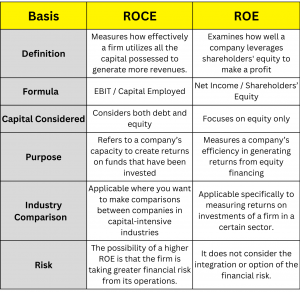
Difference Between ROCE and ROE
Bottom Line
Return on Capital Employed (ROCE) and Return on Equity (ROE) are major financial metrics that provide insights akin to a company’s overall profitability. Both metrics come with their pros and cons. ROCE is a more comprehensive way as it includes both debt and equity, making it easy to evaluate capital-intensive companies. Talking about ROE focuses on how a company earns profit from its shareholders’ equity. This makes it a good metric for equity investors.
Therefore, you must introspect yourself and ask what kind of investment you are planning to make. Depending on your preferences, pick the metric which aligns best with your investment decision.
Please share your thoughts on this post by leaving a reply in the comments section.
Also, check out our recent post on: “What is Alpha and Beta in Mutual Funds| How it is Calculated?“
To learn more about mutual funds, contact us via Phone, WhatsApp, Email, or visit our Website. Additionally, you can download the Prodigy Pro app to start investing today!
Disclaimer – This article is for educational purposes only and by no means intends to substitute expert guidance. Mutual fund investments are subject to market risks. Please read the scheme related document carefully before investing.