Generally, tracking error determines the dissimilarity between the price behavior of an index or benchmark and the status of an investment portfolio. To get an advantage from the same in regards to investment portfolio management, one should need to understand the concept of tracking error and how it works.
If you want to invest in passive funds and index funds, you should have to understand the involved fund’s tracking error. The tracking error of a mutual fund is as significant as the fund’s previous performance.
Read further to understand what tracking error is, the formula, examples, and the impact it could have on the returns of your mutual fund investment.
What is a Tracking Error?
Tracking error can be defined as the risk ratio of an investment portfolio when set side by side with its benchmark. It helps to evaluate the performance of a specific investment.
It also helps in comparing the performance of how well the investment is doing against a set benchmark over a particular time. As a consequence, it acts as an indicator that helps to determine how well a fund is controlled and what are the risks associated with it.
Let’s understand this in simple words, tracking error can be determined as the difference between an investment portfolio’s returns and the index it is trying to match or beat returns.
Often tracking errors turn out to be of use in evaluating the performance of portfolio managers and is called active risk and is commonly used for ETFs, or passively managed mutual funds.
How to Calculate a Tracking Error?
Generally, there are two different methods of evaluating tracking error:
First method
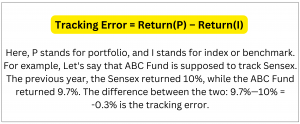
To find tracking error, subtract the benchmark’s total returns from the investment portfolio’s returns.
Second Method
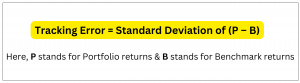
The portfolio returns are deducted from the benchmark first. Thereupon, the standard deviation of the outcome is evaluated by making use of this tracking error formula:
Example of Tracking Error Calculation
Suppose a technology-focused mutual fund is benchmarked to the Nasdaq-100 index. The returns for both the index and the mutual fund over 4 years are as follows:Nifty 50 Index Index Returns:
- Year 1: 18%
- Year 2: 10%
- Year 3: 15%
- Year 4: 8%
Mutual Fund Returns:
- Year 1: 20%
- Year 2: 12%
- Year 3: 13%
- Year 4: 7%
Step-by-Step Calculation:
- Calculate the differences between the mutual fund’s returns and the benchmark’s returns for each year:
- Year 1: 20%–18% = 2%
- Year 2: 12% –10% = 2%
- Year 3: 13% –15% = –2%
- Year 4: 7% –8% = –1%
- List of differences: 2%, 2%,–2%, –1%
- Calculate the standard deviation of these differences:
- Standard Deviation = 3.1875% ≈ 1.79%
Tracking Error (TE) = 1.79%
This example demonstrates how tracking error measures the consistency of a mutual fund’s returns compared to its benchmark.
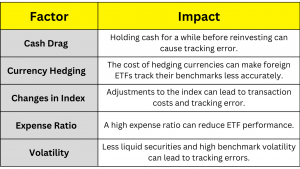
Factors Impacting Tracking Error
Different factors incline to impact the tracking error. For instance, the table underlines the factors that impact the ETF’s tracking error.
What is an Ideal Tracking Error?
The investment’s portfolio strategy and style determines whether a tracking error is acceptable or not. Generally, a smaller number signifies tightly bound portfolio earnings against benchmark returns.
Importance of Tracking Error
These points show why tracking error is important:
- Measuring Performance: Tracking error helps you see how well a portfolio is doing compared to its benchmark or index.
- Consistency Check: It shows how consistent the portfolio’s returns are.
- Simple Comparison: It turns the difference between the portfolio and the benchmark into an easy-to-understand number.
- Informed Decisions: It gives a clear view for making better decisions.
Limitations of Tracking Error
Tracking error measures deviation in performance from an index but fails to categorize whether the fund has overperformed or underperformed the benchmark but on its own it is proof of neither. Generally, investors prefer to go with funds that have low tracking errors. On the other hand, low tracking error indicates close-synchronous performance with indicies performance. Anyway, tracking errors does not help differentiate between the two immediately.
Final Words
Tracking error is a useful tool for comparing a fund’s performance to its benchmark. Despite its limitations, it helps in understanding consistency and making informed investment decisions.
So, here comes the end of the article! We hope that you have understood every important element of tracking error.
Please share your thoughts on this post by leaving a reply in the comments section. Contact us via Phone, WhatsApp, or Email to learn more about mutual funds, or visit our website. Alternatively, you can download the Prodigy Pro app to start investing today!
Disclaimer – This article is for educational purposes only and does not intend to substitute expert guidance. Mutual fund investments are subject to market risks. Please read the scheme-related document carefully before investing.