SEBI RISKOMETER
Imagine yourself as an investor deciding which mutual fund strategy to invest in! If only there was a tool to assist you in assessing the risks involved with the schemes that pique your attention, right? Well, there is one. SEBI’s Riskometer provides the solution you’ve been looking for.
Investing is the single most significant part of wealth growth. However, investing always involves risk, and managing that risk is critical to reaching your financial objectives. SEBI has developed a variety of instruments and indicators over time, and we will discuss one of them in this blog today: the riskometer!
The riskometer: what is it?
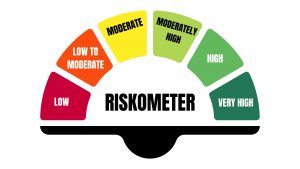
An instrument that helps investors gauge the risks connected to a particular mutual fund is the Riskometer. It offers a simple way to evaluate and analyze the possible risk profile of a mutual fund. Based on their risk tolerance and financial goals, investors can make more educated and thoughtful investing decisions with the help of the Riskometer, which looks like a car’s speedometer and displays six risk levels.
HISTORY OF SEBI RISKOMETER!
SEBI launched the Riskometer in 2010 and all companies have been required to comply and incorporate it in all the listed funds . The current version of the Riskometer was upgraded in 2015, after the previous model used for product labelling in 2013 was highlighted as insufficient. It failed to categorise the appropriate amount of risk that a mutual fund carried, and numerous funds fell into the same category, making it impossible to distinguish between the risks connected with different funds.
The riskometer model, launched in 2015, separates funds into smaller categories, making it easier for an investor to assess two or more mutual funds and select one based on their risk appetite!
The Riskometer has been designed in such a way that it is more accurate than old risk classification tools as it takes into account many factors to assess the risk associated with a fund, such as
- Types of assets
- Volatility of assets
- Investment strategy of the fund
RISK LEVELS OF A RISKOMETER: EXPLAINED!
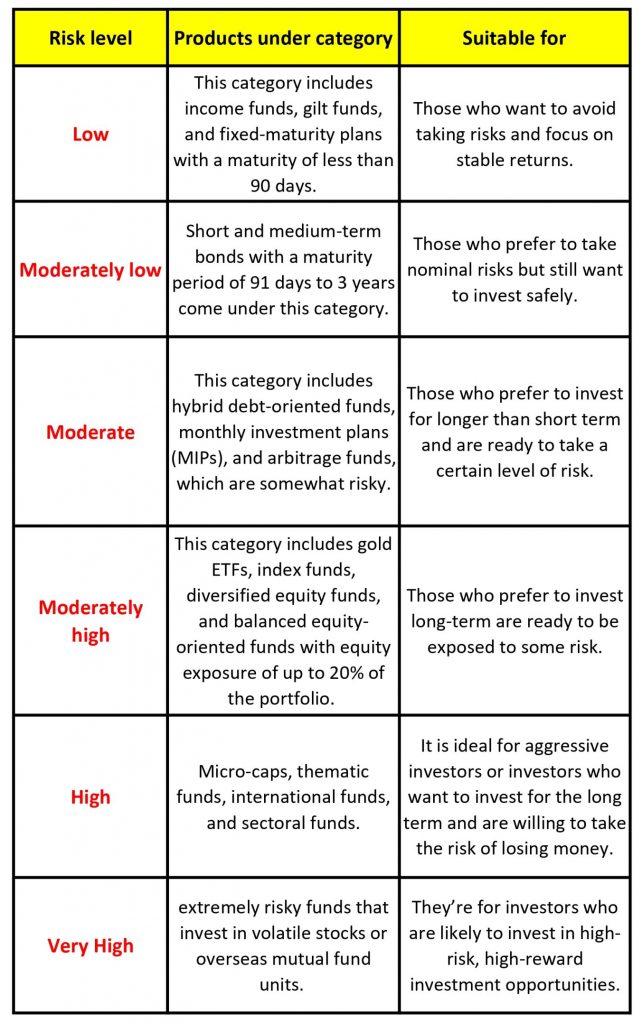
SEBI has reformed the way of representation of categorization of risk from color codes to a speedometer-equivalent graphic and we have covered it in depth for your understanding:
MEASURED BY RISKOMETER: TYPES OF RISKS IN Mutual Funds!
After looking at the numerous risk levels that a Riskometer shows, let’s talk about the dangers associated with investing in various mutual fund kinds.
Because they are very sensitive to changes in the stock market, equity funds typically have a risk profile that ranges from moderately high to extremely high.
The risk profile of debt funds is generally lower than that of equity funds; nevertheless, the specific fund you invest in will determine the exact amount of risk.
Because they mix debt and equity components, hybrid funds have a moderate risk profile.
Funds that focus only on a single, focused sector make up sectoral funds, which have a very high risk.
Due to their focus on short-term debt instruments, liquid funds often have a low-risk profile.
WHAT TO DO AS AN INVESTOR?
There are so many schemes out there to choose from. With the help of the Riskometer, an individual investor should be able to make informed decisions between various available schemes according to their risk appetite and select a fund that aligns with their financial objectives. This Riskometer is especially a blessing in disguise for investors who are new to the world of investing and rely on the advice of their financial advisors. It would caution them and allow them to study various funds while making essential investment decisions!
However, please note that the Riskometer provides a signal of the level of risk in various investments. Given the associated risks with these investments, decisions should be made after utmost consideration. The riskometer should not be the only indicator based on which you make investing decisions.
Also, Check – Role of the SEBI for Investors
ON A PARTING NOTE….
Alright, phew! It was a lot to process. You should take your time and make thoughtful judgments about where to put your money, so don’t stress!
Contact us via Phone, WhatsApp, or Email to learn more about mutual funds, or visit our Website. Additionally, you can download the Prodigy Pro app to start investing today!
Disclaimer – This article is for educational purposes only and does not intend to substitute expert guidance. Mutual fund investments are subject to market risks. Please read all scheme-related documents carefully before investing.